
An Imagined Bond with Mrs. Haagstromm
The RoomThis thread follows the protagonist’s imagined identification with Mrs. Haagstromm’s suffering, showing how claimed compassion for her is repeatedly entangled with his desire to punish and control others.
increasing Bearing strength in each event
 decreasing
Bearing strength in each eventdecreasingA Victim Enters His Story
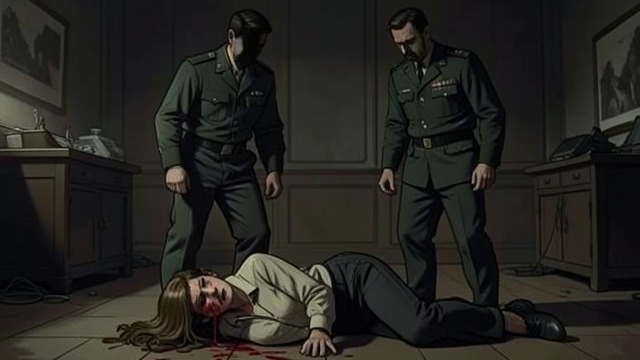
A Victim Enters His Story
A story of assault
The protagonist imagines a young woman attacked by two police officers and left with severe injuries. He places her case inside the public campaign he has invented, presenting it as evidence that abuse can destroy an innocent person’s life.
Identification at a distance
He speaks as though the woman’s suffering has become part of his own moral purpose. Yet their connection is mediated entirely through his imagined account; he does not describe a mutual relationship or direct knowledge of her.
Mrs. Haagstromm becomes a figure through whom the protagonist can imagine speaking for vulnerable people. That identification gives his fantasy an appearance of empathy while also furnishing material for his personal struggle against authority.
Her Story Before Senators

Her Story Before Senators
Public testimony for an absent woman
Before the United States Senate Special Investigating Committee, the protagonist imagines describing Mrs. Haagstromm’s assault, injuries, and psychological collapse. He gives her suffering a public audience that, in the imagined scene, cannot ignore it.
Advocacy as self-importance
He presents the testimony as service to a woman unable to speak for herself. At the same time, the scene centers his own voice: he becomes the witness who interprets her experience and the figure whose courage supposedly brings it to light.
The imagined bond therefore carries both moral urgency and self-dramatization. His concern for the victim cannot be separated from the acclaim he anticipates receiving for representing her.
Compassion Turns to Retribution

Compassion Turns to Retribution
An appeal for justice
The protagonist’s imagined public account ends with solemn language about the injured woman and the damage done to her family. He frames her case as proof that abuse can reach beyond its immediate victim.
The return of personal rage
Back in the cell, the focus shifts from her pain to his confinement and his hatred of those who hold power. His thoughts turn to torture and revenge, and the supposed campaign for justice becomes inseparable from fantasies of making others suffer.
The emotional connection to Mrs. Haagstromm is consequently unstable. Her imagined suffering briefly draws out concern, but the protagonist repeatedly absorbs that concern into a private drama of injury, anger, and retaliation.
The Officers’ Imagined Punishment

The Officers’ Imagined Punishment
A promise of protection
The protagonist imagines the accused officers being examined, discredited, and confined to a mental hospital. He treats their removal from the street as a way of protecting Mrs. Haagstromm and preventing further harm.
Punishment exceeds protection
His imagined plans extend beyond containment into years of humiliation and suffering, including torment directed at the officers’ families. He wants not only to stop danger but to ensure that the perpetrators remember him as the source of their misery.
This escalation reveals the limits of his identification with the victim. Rather than allowing her recovery to define the purpose of his campaign, he makes her case the justification for an expanding fantasy of personal power.
No Shared Recovery

No Shared Recovery
A victim reduced to a symbol
The imagined campaign never gives Mrs. Haagstromm a sustained voice or a shared future with the protagonist. Her suffering remains a story he tells, revisits, and uses to organize his fantasies of authority and revenge.
The bond collapses inward
As the narrative returns repeatedly to the cell, the protagonist’s attention contracts toward his own pain and isolation. The woman’s story no longer offers a durable connection to another person; it is folded into his private cycles of anger, fantasy, and despair.
The thread ends without reconciliation or evidence of real contact. Its significance lies in the contrast between the protagonist’s language of solidarity and the self-enclosed nature of the emotional bond he imagines.
During the imagined campaign against police abuse
During the imagined Senate testimony
After the imagined testimony, back in the cell
During the imagined hearings and commitment
Near the novel’s ending
